Qué lo qué — Dominican Meaning, Definition and Usage
Learn what 'qué lo qué' means in Dominican Spanish, how Dominicans use this famous greeting, and the cultural context behind the expression
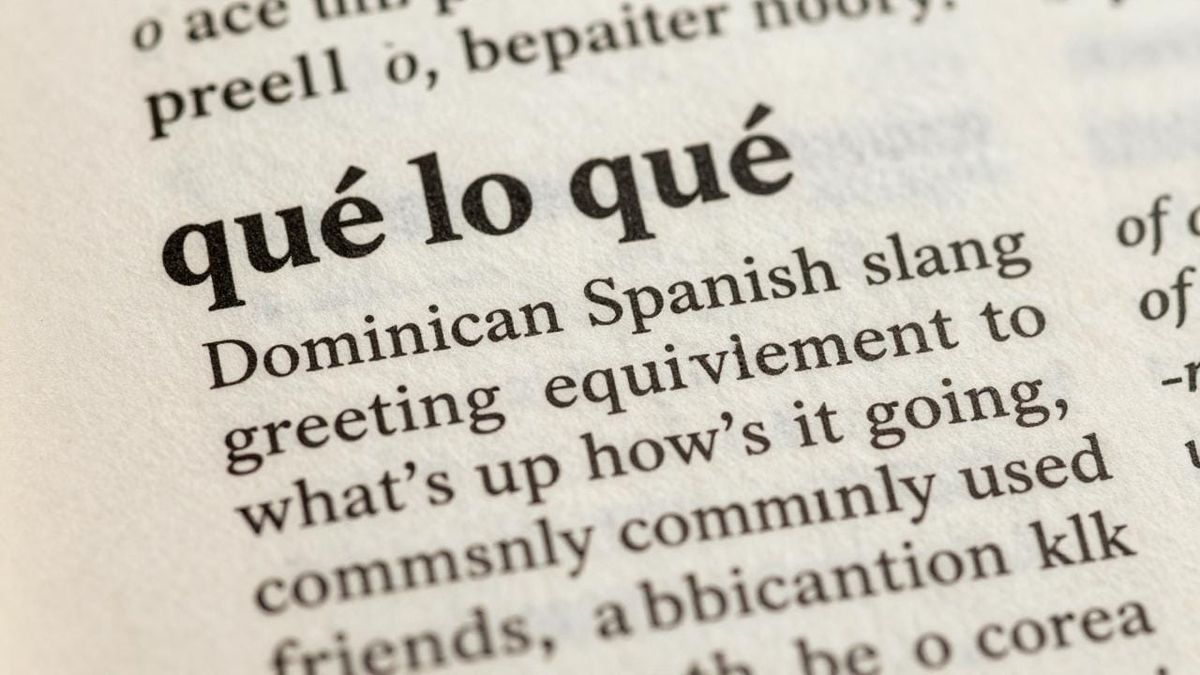
Qué lo qué
Pronunciation:
keh loh keh
Part of speech:
Informal expression / greeting / colloquial phrase
Gender:
Not applicable
English equivalent:
"What is up?", "What's going on?", "How's it going?"
Meaning:
"Qué lo qué" is one of the most recognizable informal greetings in Dominican Spanish. It is used to ask how someone is doing, what is happening, or simply to acknowledge another person in a friendly way. Although it literally resembles the question "what the what?", its real meaning is closer to "what's up?" or "how are things?"
The expression is strongly associated with everyday Dominican speech, especially among friends, family members, and younger generations, although many Dominicans of different ages use it naturally in informal settings.
What does "qué lo qué" mean in Dominican Spanish?
The expression qué lo qué is a shortened colloquial form of ¿qué es lo que hay? or ¿qué es lo que pasa?, expressions that can roughly be understood as "what is happening?" or "what's going on?"
Over time, Dominican speakers shortened and transformed the phrase into the much faster and more casual:
¿Qué lo qué?
The meaning is not a literal request for information. In most situations, it functions as a social greeting rather than a serious question.
For example, when two friends meet:
¿Qué lo qué, hermano?
usually means:
"What's up, brother?"
"How are you doing?"
The expression carries a sense of familiarity and friendliness. The speaker is showing recognition and connection rather than requesting a detailed explanation.
How Dominicans use "qué lo qué"
"Qué lo qué" is mainly used in informal situations.
Common contexts include:
- greeting friends
- starting a casual conversation
- answering a phone call from someone familiar
- acknowledging someone in the street
- greeting relatives or acquaintances
Examples:
¿Qué lo qué, mi hermano? ¿Todo bien?
Meaning:
"What's up, my brother? Everything good?"
A common response is simply:
Todo bien.
("Everything good.")
or:
Aquí, tranquilo.
("Here, taking it easy.")
The expression can also be shortened further in very casual speech:
¿Qué lo qué?
or:
¿Lo qué?
depending on the speaker and context.
Social meaning and tone
The phrase communicates:
- familiarity
- friendliness
- informality
- Dominican identity
It is not normally used in:
- formal business meetings
- official communication
- interactions with strangers where politeness and distance are expected
A Spanish learner visiting the Dominican Republic can use it with friends, younger people, or in relaxed social situations. However, using it immediately with everyone may feel unnatural because it implies a certain level of familiarity.
A visitor saying:
¿Qué lo qué?
to a taxi driver, shop employee, or older stranger may receive a smile, but whether it feels natural depends heavily on the relationship and context.
Examples of "qué lo qué" in Dominican Spanish
"¡Qué lo qué, Juan! ¿Cómo tú estás?"
English:
"What's up, Juan? How are you?"
"¿Qué lo qué? Hace tiempo que no te veía."
English:
"What's up? I haven't seen you in a long time."
"Llegué al colmado y el dueño me dijo: '¿Qué lo qué, campeón?'"
English:
"I arrived at the corner store and the owner said: 'What's up, champ?'"
Cultural background
"Qué lo qué" has become one of the most internationally recognized symbols of Dominican informal speech. Along with words such as vaina, tiguere, and guagua, it represents the creativity and speed of Dominican everyday Spanish.
The expression reflects an important feature of Dominican communication: greetings often carry emotional meaning beyond the words themselves. A greeting is not only about exchanging information; it is a way of showing warmth, recognition, and social connection.
The phrase is also strongly associated with Dominican popular culture, including music, social media, and Dominican communities abroad. Many Dominicans living outside the country use expressions like "qué lo qué" as a cultural marker that immediately connects them with home.
Similar Dominican words and expressions
- ¿Qué es lo que hay? — A longer expression that is considered one possible source of the shortened "qué lo qué." It means "what's happening?" or "what's going on?"
- Dime a ver — A casual Dominican expression meaning roughly "tell me" or "what's up?"
- Todo bien — A common response meaning "everything is good."
- Aquí tranquilo — A relaxed response meaning "just taking it easy."
Regional variations
"Qué lo qué" is widely understood throughout the Dominican Republic, although the frequency of use may vary depending on age, personality, and social environment.
Younger Dominicans and people in urban environments may use it more frequently, especially in casual conversations and online communication.
Older generations may recognize and use it but may prefer other greetings depending on the situation.
There are also differences in pronunciation. In fast Dominican speech, sounds may be reduced, making the expression shorter and more compressed.
Is "qué lo qué" used outside the Dominican Republic?
The phrase is strongly associated with the Dominican Republic, although similar expressions exist throughout the Spanish-speaking Caribbean and Latin America.
Other countries have their own informal greetings, such as:
- ¿Qué onda? in Mexico
- ¿Qué más? in Colombia and Venezuela
- ¿Qué pasa? in many Spanish-speaking countries
What makes qué lo qué distinctly Dominican is its pronunciation, rhythm, and role as a cultural marker of Dominican identity.
Among Dominican communities abroad, the expression is often immediately recognizable as Dominican Spanish.
Quick summary
| Topic | Details |
|---|---|
| Meaning | Informal greeting similar to "what's up?" |
| English equivalent | What's up? / How's it going? |
| Used by | Dominicans in informal situations |
| Register | Informal slang/greeting |
| Category | Expression |